
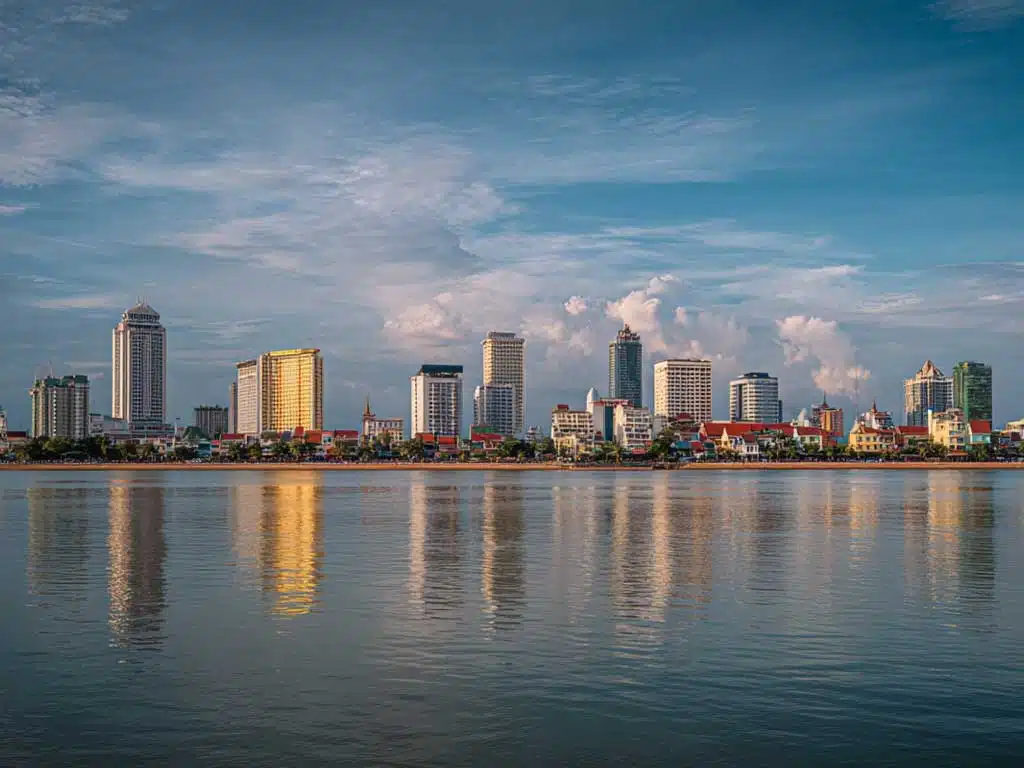
Phnom Penh Cambodia is one of the most surprising capital cities in Southeast Asia. It feels busy, layered, elegant, and raw all at once. Some travelers arrive expecting only a stopover, then leave feeling like they found one of the region’s most interesting urban destinations.
This city stands out for more than its role as Cambodia’s capital. Phnom Penh has a strong riverside setting, a deep and difficult history, beautiful temple and colonial architecture, lively markets, and a food scene that feels both local and evolving. If you want a place with character, contrast, and substance, Phnom Penh deserves more attention than it often gets.
In this guide, you’ll see what makes the city worth visiting, from its atmosphere and landmarks to its museums, street life, and cultural appeal.
Table of Contents Phnom Penh Cambodia
What makes Phnom Penh different from other Southeast Asian capitals
Phnom Penh does not try to overwhelm you with polished perfection. That is part of its appeal. The city feels lived-in and real, with wide boulevards, historic buildings, river views, buzzing traffic, and neighborhoods that shift quickly from grand to everyday.
It sits at the meeting point of the Mekong and Tonlé Sap rivers, and that river presence shapes the mood of the city. Along the waterfront, you get a more open and airy side of Phnom Penh. Walk a few streets inland, and the pace changes. Cafes, markets, local shops, temples, and daily street scenes give the city its energy.
This contrast is one of the main reasons Phnom Penh stays with people. It is not just a place to tick off landmarks. It is a place to feel.
1. The riverfront gives Phnom Penh its most memorable setting
One of the first things many travelers notice is the city’s riverfront. The Sisowath Quay area is one of the easiest places to understand Phnom Penh’s atmosphere. It brings together river views, restaurants, parks, traffic, local life, and sunset light in a way that feels both scenic and active.
During the day, the waterfront can feel hot and bright, but by late afternoon it becomes much more inviting. Locals gather, visitors stroll, and the city seems to soften for a few hours. It is one of the best places to get a first impression of Phnom Penh without needing a plan.
The riverfront also gives the city a sense of space that many capitals lack. Even when the streets feel busy, the water opens everything up.
2. Phnom Penh Cambodia carries history in a powerful way
Phnom Penh is not a shallow destination. Its history is visible, and at times heavy, but that is part of what makes the city important.
A visit here often includes places that help travelers understand Cambodia’s past, especially the Khmer Rouge period. The Tuol Sleng Genocide Museum is one of the city’s most significant sites. It is not an easy visit, but it offers necessary context for understanding modern Cambodia and the resilience of its people. For official visitor information on Cambodia’s cultural sites, the Ministry of Tourism Cambodia is a useful resource.
The city’s historic weight gives Phnom Penh more depth than travelers sometimes expect. You do not just see attractions here. You engage with stories that still matter.
3. The Royal Palace area adds elegance and visual beauty
Phnom Penh has many busy and rough-edged parts, but the Royal Palace area shows another side of the city. This section of Phnom Penh feels formal, refined, and visually striking.
The palace complex, with its golden roofs and traditional Khmer design, is one of the city’s best-known landmarks. Nearby, the Silver Pagoda adds to that sense of grandeur. These sites are important not just for their beauty, but for the way they reflect Cambodia’s artistic and royal heritage.
This part of the city also helps balance Phnom Penh’s identity. It is not only intense and historical. It can also be graceful and quietly impressive.
4. The museums give the city real cultural depth
Many cities have museums that feel optional. In Phnom Penh, they feel essential.
The National Museum of Cambodia is one of the best places to understand Khmer art and history in a broader way. Its collection helps connect Phnom Penh to the wider story of Cambodia, from ancient heritage to cultural continuity. Even the museum building itself is worth seeing, with its traditional design and peaceful courtyard atmosphere.
What makes these museums work so well is that they do more than display objects. They help explain the country behind the capital. If you want your trip to feel meaningful, this is a big part of Phnom Penh’s appeal.
5. Markets show the city at its most energetic
Markets are one of the easiest ways to connect with Phnom Penh’s rhythm. They are lively, practical, crowded, colorful, and full of small details that tell you a lot about local life.
Central Market is one of the best-known examples, partly because of its striking Art Deco building. It is worth seeing for the architecture alone, but the atmosphere inside matters just as much. You find jewelry, clothes, souvenirs, household goods, and the constant movement that gives the place energy.
Russian Market offers a different feel. It is more tangled, more compact, and often more immersive. Together, these markets show both the commercial side of Phnom Penh and the city’s everyday pulse.
6. The food scene feels local first, trendy second
Phnom Penh may not always get the same food hype as Bangkok or Ho Chi Minh City, but that is part of what makes it enjoyable. The city’s food scene still feels grounded.
You can find classic Cambodian dishes, street-side snacks, noodle soups, grilled meats, fresh tropical fruit, and busy local eateries that give the city real flavor. At the same time, Phnom Penh has a growing cafe and restaurant scene that adds range without fully smoothing away its identity.
This mix works well for travelers. You can enjoy traditional Cambodian food, try market snacks, and still find stylish dining spaces when you want a slower meal. The city feels approachable rather than overdesigned.
7. Architecture in Phnom Penh tells several stories at once
Phnom Penh is visually interesting because it is not defined by one single style. Khmer elements, Buddhist temples, French colonial influence, post-independence modernism, and newer urban development all sit side by side.
That variety gives the city texture. On one street, you may see a faded colonial facade. On another, a gleaming newer building. Nearby, there may be a temple compound or a local block with everyday storefronts and tangled power lines.
This layered look gives Phnom Penh character. It does not feel staged. It feels like a city shaped by history, survival, and change.
8. Phnom Penh Cambodia has an atmosphere that feels both intense and welcoming
One of the hardest things to explain about Phnom Penh Cambodia is its atmosphere. It can feel chaotic at first, especially if you arrive from a quieter destination. The traffic, heat, and street movement are immediate.
But once you settle in, the city often starts to feel more welcoming than intimidating. There is a directness to Phnom Penh that many travelers end up appreciating. The riverfront is open, the neighborhoods have personality, and the city’s daily life is always close to the surface.
That sense of honesty is part of what makes Phnom Penh memorable. It may not charm everyone in the first hour, but it often grows on people quickly.
9. It offers a fuller picture of Cambodia
For many travelers, Cambodia begins with Angkor Wat. That makes sense, but Phnom Penh adds something very different and equally important.
This city helps you understand modern Cambodia through politics, history, art, religion, food, and urban life. It shows a country that is not only ancient and monumental, but also contemporary, complex, and changing.
That broader view is one of the strongest reasons to visit. Phnom Penh gives travelers more context, more human texture, and a more complete sense of the country.
Why Phnom Penh is worth visiting
Phnom Penh is worth visiting because it has substance. It offers beauty, but not only beauty. It offers history, but not in a distant way. It offers culture, food, architecture, and riverfront life in a form that feels active and real.
If you want a destination that combines landmarks with atmosphere, Phnom Penh delivers. It is one of those cities where the value comes not just from what you see, but from how the place feels while you are there. That is why it stands out, and why many travelers leave with stronger memories of Phnom Penh than they expected.
